Oracle OBIEE to Power BI Migration Guide (2026)
Migrate Oracle OBIEE / OAS to Power BI: map the RPD semantic layer, Analyses, and BI Publisher to models, reports, and paginated. Plan, costs, pitfalls.
Oracle Business Intelligence Enterprise Edition (OBIEE), and its successor Oracle Analytics Server (OAS), are built around one of the most rigorous semantic layers in enterprise BI: the RPD repository. That rigor is exactly why teams hesitate to migrate Oracle OBIEE to Power BI — and exactly why a careful migration works so well, because the RPD is a precise specification you can rebuild from. This guide maps OBIEE and OAS to Power BI, with special attention to translating the three-layer RPD into a Power BI semantic model. If you are still comparing platforms, start with our Oracle Analytics vs Power BI comparison.
Why Enterprises Migrate Off OBIEE / OAS
- Total cost of ownership. OBIEE and OAS infrastructure, licensing, and administration are heavy. Power BI on Fabric consolidates compute and licensing into a predictable capacity model.
- User experience. OBIEE's Analyses and dashboards feel dated next to Power BI's interactive, self-service experience, and adoption beyond the analyst core is often limited.
- Microsoft estate alignment. Organizations standardizing on Azure, Microsoft 365, and Fabric want their semantic layer inside that governed, Copilot-enabled ecosystem.
- Administrative burden. Maintaining the RPD, BI Server, and Presentation Services is specialist-heavy work that Power BI and Fabric substantially reduce.
Component Mapping: OBIEE / OAS to Power BI
| Oracle OBIEE / OAS | Power BI Equivalent | Migration Notes |
|---|---|---|
| RPD Business Model & Mapping layer | Power BI semantic model | The logical model, joins, and hierarchies become the Power BI model. |
| RPD Physical layer | Power Query connections | Source connections and physical joins move into Power Query and the model. |
| RPD Presentation layer | Curated model fields + perspectives | Presentation subject areas map to a clean, business-friendly model surface. |
| Analyses / Answers | Power BI visuals and reports | Interactive analysis maps directly. |
| Dashboards | Power BI reports and apps | Consolidate into governed report apps. |
| BI Publisher | Power BI paginated reports | Pixel-perfect, print-ready, and bursting output. |
| Aggregate/logical dimensions | Aggregation tables + DAX | Aggregate navigation maps to Power BI aggregations or Direct Lake. |
| Application roles / data filters | Row-level security (RLS) | OBIEE data-level security maps to RLS roles. |
Translating the RPD Semantic Layer
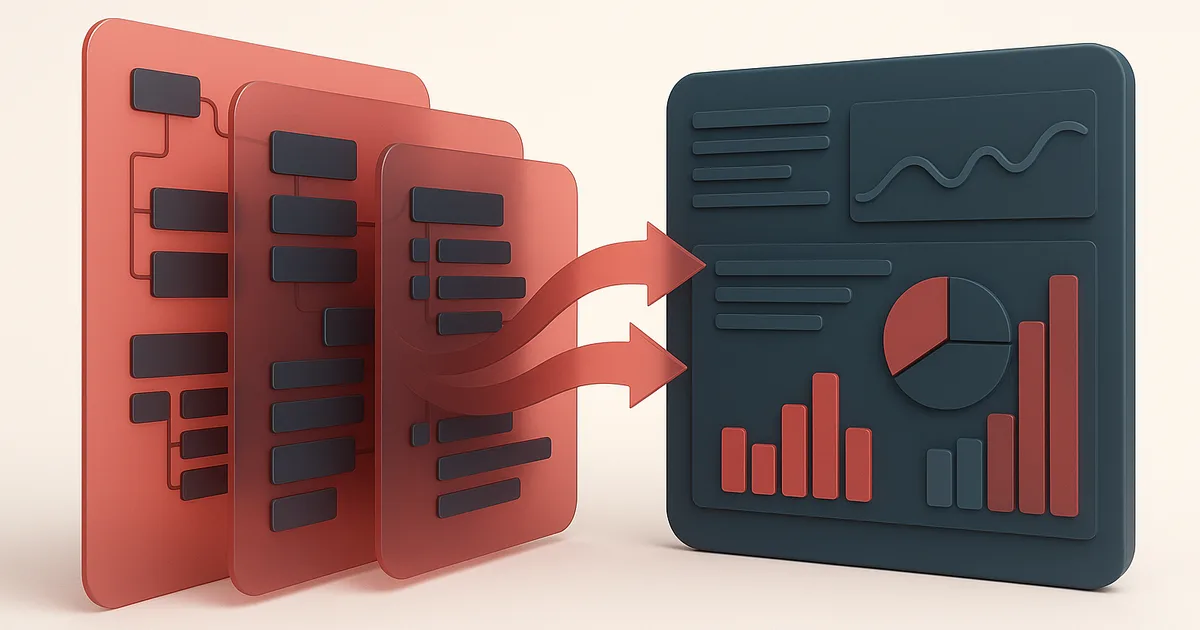
The RPD is OBIEE's crown jewel: a three-layer model (Physical, Business Model & Mapping, Presentation) that enforces consistent metrics and shields users from source complexity. In Power BI, that translates cleanly: the Physical layer becomes Power Query source connections, the Business Model & Mapping layer becomes the Power BI semantic model with relationships and DAX measures, and the Presentation layer becomes a curated, business-friendly field surface on that model. Logical dimensions and aggregate navigation map to Power BI hierarchies and aggregation tables, or to Direct Lake on Fabric for very large volumes.
Rebuild the RPD business logic once as a certified semantic model and rebuild Analyses on top of it. Migrating from the RPD specification — not by reverse-engineering individual Analyses — is what preserves OBIEE's single-version-of-the-truth guarantee.
A Phased Migration Approach
- Document the RPD. Treat the RPD as the authoritative specification: subject areas, logical tables, measures, hierarchies, and data filters.
- Rebuild the certified model. Recreate the business model as a governed Power BI semantic model with documented measures and RLS mirroring the data filters.
- Migrate flagship Analyses and dashboards. Recreate the highest-value content as Power BI reports, validating in parallel against OBIEE.
- Move BI Publisher workloads. Recreate pixel-perfect and bursting output as Power BI paginated reports with subscriptions.
- **Govern, train, decommission.** Establish governance, train the community, and retire the OBIEE/OAS estate after validation.
For multi-platform programs, our legacy BI migration guide frames the umbrella strategy.
Common Pitfalls
- Migrating from Analyses instead of the RPD. The RPD is the source of truth; rebuild the model from it.
- Abandoning semantic governance. Without certified central models, Power BI can reproduce metric drift the RPD was designed to prevent.
- Skipping BI Publisher replacement. Interactive Power BI does not replace pixel-perfect BI Publisher output; paginated reports do.
- Underestimating scale. Large OBIEE deployments should evaluate Fabric capacity and Direct Lake up front so performance holds for thousands of users.
Cost and Timeline
An OBIEE/OAS migration is sized by RPD complexity and user scale. A focused subject-area migration runs 16-24 weeks; a full enterprise RPD migration with many subject areas and heavy BI Publisher workloads is a multi-quarter program. The offset is a large reduction in infrastructure and administration cost plus modern-experience adoption gains. Model licensing in our pricing guide.
Planning an OBIEE or OAS migration? Contact Power BI Consulting for an assessment that starts from your RPD and produces a certified-model rebuild plan. If you run other legacy platforms, see our IBM Cognos and MicroStrategy migration guides.
Frequently Asked Questions
Can Power BI handle a semantic layer as rigorous as the OBIEE RPD?
Yes, when built deliberately. The RPD three layers translate cleanly: the Physical layer becomes Power Query connections, the Business Model & Mapping layer becomes the Power BI semantic model with relationships and DAX measures, and the Presentation layer becomes a curated field surface. Certified central models on Fabric preserve single-version-of-the-truth at scale.
How is the OBIEE RPD migrated to Power BI?
You migrate from the RPD specification, not by reverse-engineering individual Analyses. Subject areas, logical tables, measures, hierarchies, and data filters in the RPD become the authoritative blueprint for the Power BI semantic model, its DAX measures, and its row-level security roles.
What replaces Oracle BI Publisher in Power BI?
BI Publisher pixel-perfect and bursting output maps to Power BI paginated reports, which provide print-ready operational output with subscriptions and data-driven distribution. Interactive Power BI reports do not replace this class of output, so paginated reports are a required part of the migration.
How long does an OBIEE to Power BI migration take?
A focused subject-area migration runs 16-24 weeks, while a full enterprise RPD migration with many subject areas and heavy BI Publisher workloads is a multi-quarter program. Timeline is driven mainly by RPD complexity and user scale rather than raw report count.
Does OAS (Oracle Analytics Server) migrate the same way as OBIEE?
Yes. OAS is the modern successor to OBIEE and retains the RPD-based architecture, so the same approach applies: document the RPD, rebuild it as a certified Power BI semantic model, recreate Analyses and dashboards as Power BI reports, and move BI Publisher workloads to paginated reports.